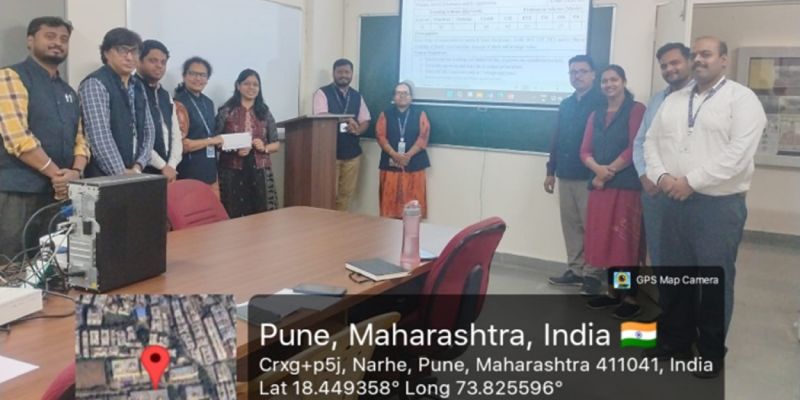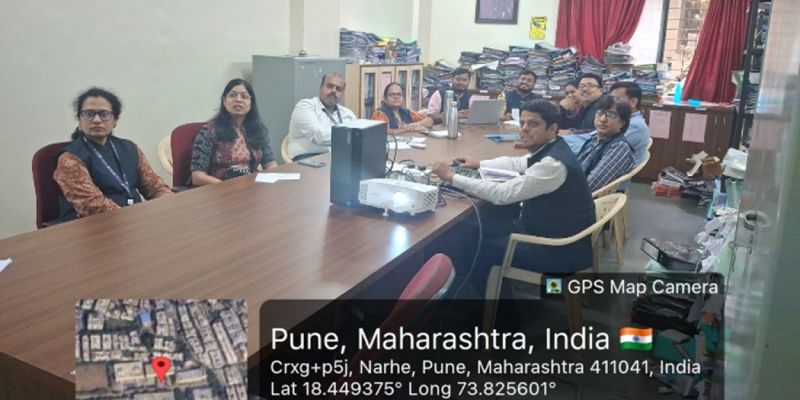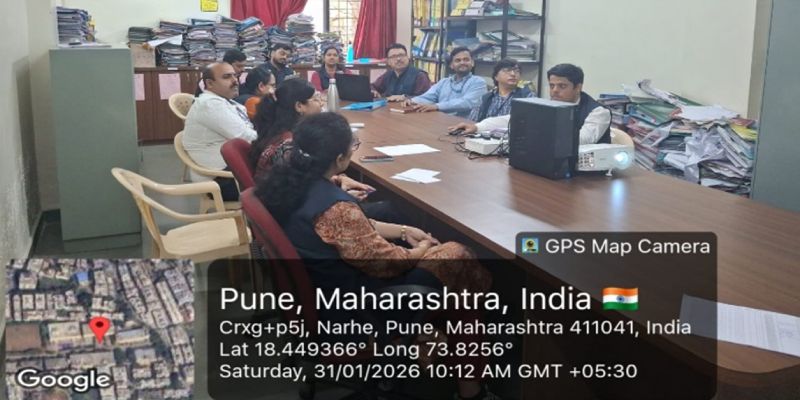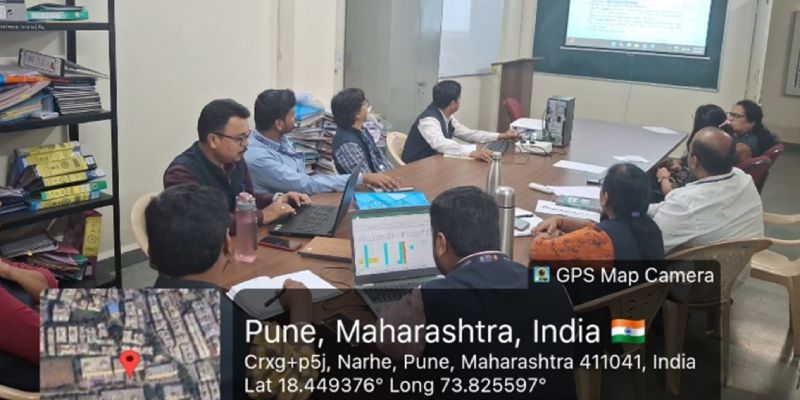
Name of Expert: Dr. Ritika Asati, Assistant Professor, COEP Technological University, Pune
Topic of the session: Faculty development Programme organized on the subject, Power Electronics and its Applications (PEA) (SY B Tech Sem II)
Beneficiaries: All faculty of the Electrical Engineering Department
No. of participants: 10
Venue: Conference room, Department of Electrical Engineering, ZCOER, Narhe, Pune.
A. Overview:
The Department of Electrical Engineering, ZES’s Zeal College of Engineering & Research (ZCOER), Pune, organized a Faculty Development Programme (FDP) on 24 January 2026 for the faculty members of the Electrical Engineering Department. The FDP was focused on effective content delivery, syllabus elaboration, and application-oriented teaching strategies for the subject Power Electronics and its Applications (PEA) prescribed for Second Year B. Tech, Semester-II. The session was conducted from 02:00 p.m. to 04:00 p.m. in the Department Conference Room (C-211). The Programme aimed to enhance faculty understanding of numerical methods, strengthen pedagogical practices, and ensure effective alignment with Outcome-Based Education (OBE) principles as well as NBA and NAAC accreditation requirements.
B. Objectives of the FDP:
The key objectives of the FDP were:
- To discuss the syllabus elaboration and content delivery framework proposed by the subject teacher.
- To discuss application-based teaching approaches that enable students to understand and apply computational methods to real-world Electrical Engineering problems.
- To review and rationalize contact hours, unit sequencing, and laboratory session planning.
- To ensure effective alignment with Outcome-Based Education (OBE) principles and compliance with NBA, NAAC, and ISO quality frameworks.
- To promote activity-based, experiential, and student-centric learning approaches.
C. Resource Person and Participants:
The FDP was enriched by the presence of Dr. Ritika Asati, Assistant Professor, COEP Technological University, Pune, who provided expert academic insights and constructive recommendations. The Programme was attended by all faculty members of the Electrical Engineering Department, ensuring collective participation and uniform implementation.
D. FDP Proceedings and Key Discussions:
Unit–I: Power Semiconductor Devices
- It was decided to avoid detailed commutation analysis (forced and natural commutation) and instead focus on conceptual understanding.
- Static and dynamic characteristics will be taught conceptually.
- Steady-state derivations will not be emphasized in examinations.
- Students will be encouraged to study applications of SCR through student presentations, with approximately 10 students per unit covering application aspects.
Unit–II: Advanced Power Devices (SiC & GaN)
- Comparative teaching of SiC MOSFET and conventional MOSFET was finalized.
- Latest applications of SiC and GaN devices, especially in renewable energy and inverter systems, will be included.
- Students will be assigned the task of reading one research paper related to SiC/GaN devices and preparing a brief consolidated report to enhance research exposure.
Unit–III: Controlled Rectifiers
- Teaching will include R, RL, and RLE load circuits for fully controlled converters.
- Output waveforms and modes of operation will be clearly explained.
- MATLAB-based simulations will be used to support theory and improve conceptual clarity.
Unit–IV: Choppers and Regulators
- Chopper and regulator concepts will be covered briefly and effectively.
- Emphasis will be given to applications such as soft starters, solar panel systems, and MPPT techniques.
- Application-oriented teaching will be prioritized over extensive derivations.
Unit–V: Inverters
- For three-phase inverters, 180° conduction mode will be taught conceptually.
- Differences in output waveforms and modes of operation will be explained.
- Equivalent circuits and phase voltage waveforms will be emphasized for understanding.
Unit–VI: Multilevel Inverters
- Multilevel inverters will be taught at a descriptive level only, without in-depth mathematical analysis.
- Basic working principles, waveforms, and industrial importance will be highlighted.
- Students will prepare a report on applications and simulations of multilevel inverter circuits.
Additional FDP Outcomes:
As an outcome of the Faculty Development Programme, the following additional academic and pedagogical enhancements were finalized for effective delivery of the Power Electronics and its Applications (PEA) course:
1. Application-Oriented Learning Enhancement
It was resolved to conduct activity for understanding application mentioned in syllabus to ensure students can effectively correlate theoretical concepts with real-world Electrical Engineering systems. The focus will remain on practical implementation and system-level understanding.
2. Structured Student Activity Plan
For each unit of the syllabus, 10 students will be involved in activity-based learning, and these students will be divided into groups of 2–4 students per group. Each group will carry out activities related to applications, block diagrams, working principles, and simulations relevant to the unit.
3. Emphasis on Practical Understanding Over Device Theory
To optimize teaching effectiveness, it was decided that there is no need to explain characteristics, commutation methods, and triggering methods in detail. Teaching will focus on application relevance and operational understanding rather than extensive device-level theory.
4. Preparation of Driver Circuit Models
Students will be encouraged to prepare driver circuit models for power electronic devices such as MOSFETs, IGBTs, GTOs, and SCRs using simulation tools or hardware models. This will help students understand gate drive requirements and practical implementation aspects.
5. Reading and Interpretation of Datasheets
Students will be trained in reading datasheets of different power electronic devices, including SCRs, MOSFETs, IGBTs, and SiC devices. Emphasis will be given to understanding ratings, switching characteristics, thermal limits, and application constraints.
6. Integration of Simulation Tools
Simulation platforms such as MATLAB and other virtual tools will be used to validate theoretical concepts and demonstrate practical applications covered in the syllabus.
Mr. Jaysing Ashok Gurav presented and elaborated on the newly structured S.Y. B. Tech syllabus for Power Electronics and its Applications (PEA), and Mr. Yogesh Dabhole systematically documented all suggestions and inputs received from the subject expert. The session witnessed active participation from all faculty members of the department, and the Programme was coordinated and conducted successfully.
The Faculty Development Programme successfully met its objectives by encouraging useful academic discussions, improving teaching methods, and strengthening curriculum implementation. The FDP helped enhance teaching effectiveness, academic quality, and accreditation preparedness of the CMP course. The department is committed to continuous improvement through such collaborative academic initiatives.