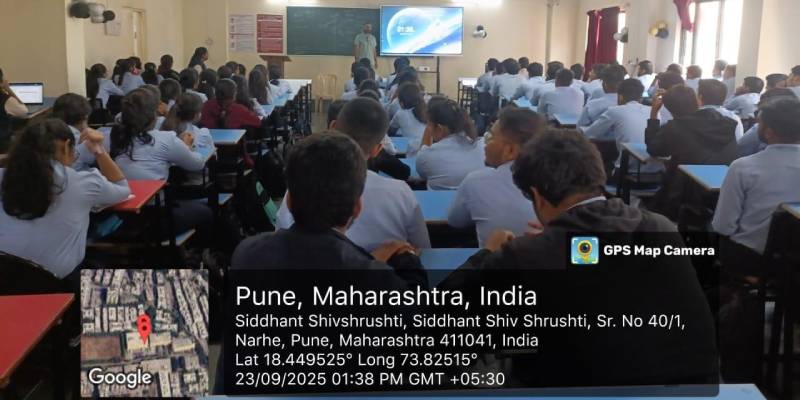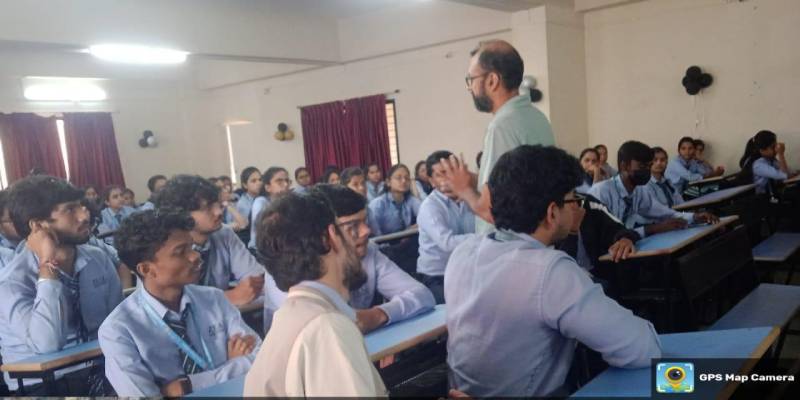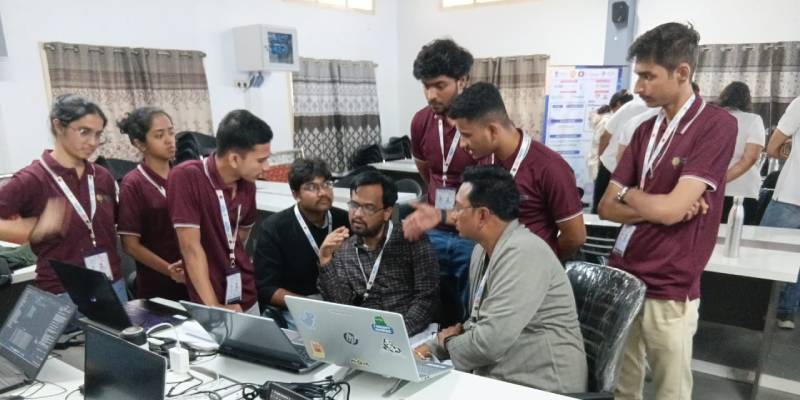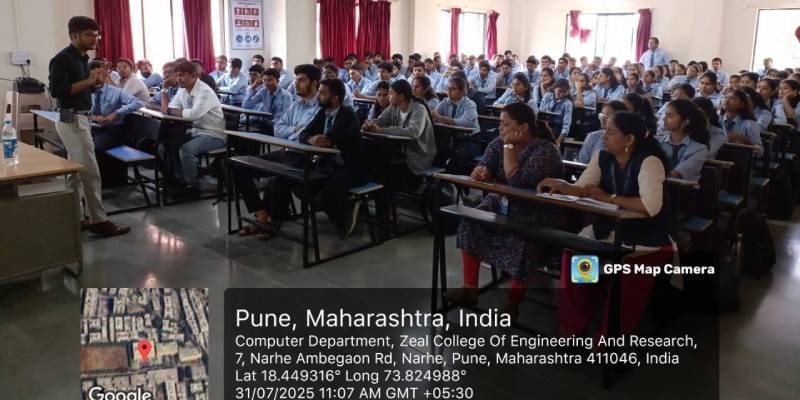
An informative and interactive expert lecture for Final Year B.Tech Computer Engineering students. The session aimed to provide in-depth knowledge of “Machine Learning algorithms, optimization techniques, applications”, and guidance on real-time projects, thereby bridging the gap between academic concepts and industry requirements.
No. of Participants: 186
Location: Computer Engineering Seminar Hall
Faculty Coordinator: Prof. Kalpana Sonval
Purpose of the Program
The expert lecture was designed to:
- Enhance students’ understanding of advanced Machine Learning algorithms and optimization techniques.
- Provide exposure to real-world applications of Machine Learning in various domains.
- Offer guidance and mentoring for final-year projects.
- Encourage critical thinking, problem-solving skills, and research-oriented mindset.
- Strengthen the connection between theoretical knowledge and practical implementation.
Session Highlights
1. Algorithms in Machine Learning:
Mr. Mandar Waghmode explained the foundational Machine Learning algorithms including supervised, unsupervised, and reinforcement learning techniques. Key concepts such as model selection, accuracy, and performance evaluation were discussed with practical examples.
2. Optimization Techniques in Machine Learning:
The session covered optimization strategies for improving model performance, including gradient descent, stochastic optimization, and hyperparameter tuning. Students were shown real-world scenarios demonstrating the importance of efficient optimization in large-scale data analysis.
3. Applications of Machine Learning:
Various applications across industries such as healthcare, finance, retail, and IoT were discussed. Students learned how algorithms can solve complex real-life problems and generate actionable insights.
4. Guidance on Real-Time Projects:
Mr. Mandar Waghmode guided students on selecting final-year projects, focusing on project scoping, dataset handling, model evaluation, and report preparation. Emphasis was placed on implementing projects with proper documentation and achieving measurable outcomes.
Outcomes
- Students gained comprehensive insights into advanced Machine Learning algorithms and their optimization.
- Exposure to industry-relevant applications strengthened practical understanding.
- Guidance on real-time project execution helped students plan and organize their final-year projects effectively.
- Students were motivated to engage in research and innovation using Machine Learning tools and techniques.
Conclusion
The expert lecture successfully enhanced students’ technical knowledge and practical skills in Machine Learning. It bridged the gap between theoretical understanding and real-world application, preparing students for both academic excellence and industry readiness.